The UCLA Center for the Developing Adolescent recognizes adolescence as a pivotal period of opportunity to shape positive outcomes for all young people. We work toward a world in which every adolescent has what they need to build their future and contribute to their community.
We empower leading policymakers and youth advocates to create modern, effective policies by connecting them with the most up-to-date research and data. We work with community leaders, youth-serving professionals, parents, and young people themselves, to inform programs and practices that support positive development for all youth based on the science of adolescent development. We talk with news organizations and reporters to increase the public understanding of adolescence as an important window of exploration and discovery.
Learn More About Our Organization:
Our History
The Center for the Developing Adolescent was founded in 2015 at UC Berkeley by Dr. Ron Dahl and a leadership team of researchers studying adolescent development. Inspired by the success of science-based efforts to better support early childhood, the Center was created to advance the understanding of the adolescent years as a similar period of opportunity when research-informed practices, programs, and policies can create positive impacts on the health, education, and social and economic success of young people. The original leadership team included Dr. Dahl along with Dr. Nick Allen, Dr. Andrew Fuligni, Dr. Adriana Galván, Dr. Jennifer Pfeifer, Dr. Ahna Suleiman, and Dr. Linda Wilbrecht.
We joined UCLA in 2021 under the leadership of Adriana Galván and Andrew Fuligni.
The Center on the Developing Adolescent was founded on two principles: 1) A recognition that adolescence is a dynamic period when young lives can spiral rapidly in negative or positive directions along the life course trajectory and 2) A belief that advances in the scientific understanding of this unique developmental period hold great promise for informing practices, programs, and policies.
Our Funders
The UCLA Center for the Developing Adolescent is generously supported by the Bezos Family Foundation, the Annie E. Casey Foundation, Spring Point Partners, and the Stuart Foundation. Major funding is also provided by the Funders for Adolescent Science Translation (FAST), a consortium that includes the Annie E. Casey Foundation, the Bezos Family Foundation, the Chan Zuckerberg Initiative, the Ford Foundation, Hemera Foundation, the Conrad N. Hilton Foundation, Hopelab, Pivotal Ventures, Spring Point Partners, the Stuart Foundation, and Raikes Foundation.
Our Activities
Our activities include:
- Partnering with the National Scientific Council on Adolescence and other experts in the field to deliver evidence-based recommendations to help adolescents succeed in the world
- Engaging in innovative research focused on adolescence, from social media’s impact to programs that help youth become thriving community members
- Collaborating with the Youth National Scientific Council on Adolescence, ensuring adolescents are directly informing the work and solutions
- Providing briefings for policymakers and youth-serving professionals
- Conducting presentations, workshops, and webinars
- Publishing working papers and briefs
- Summarizing the latest research on adolescent development
- Talking with reporters and others in the media
- Producing the podcast–Adaptivity: The Science of Adolescence
Our Commitment to the Science of Adolescence
The Center for the Developing Adolescent was founded on the belief that knowledge from the developmental science of adolescence can help us improve the lives of young people.
Our nation and broader global community are experiencing a period of rapid policy and economic changes. In this time of swift actions and reactions, we remain committed to continuing our Center’s core work: to share what we know from research about how best to support all young people now and as they grow as leaders and community members.
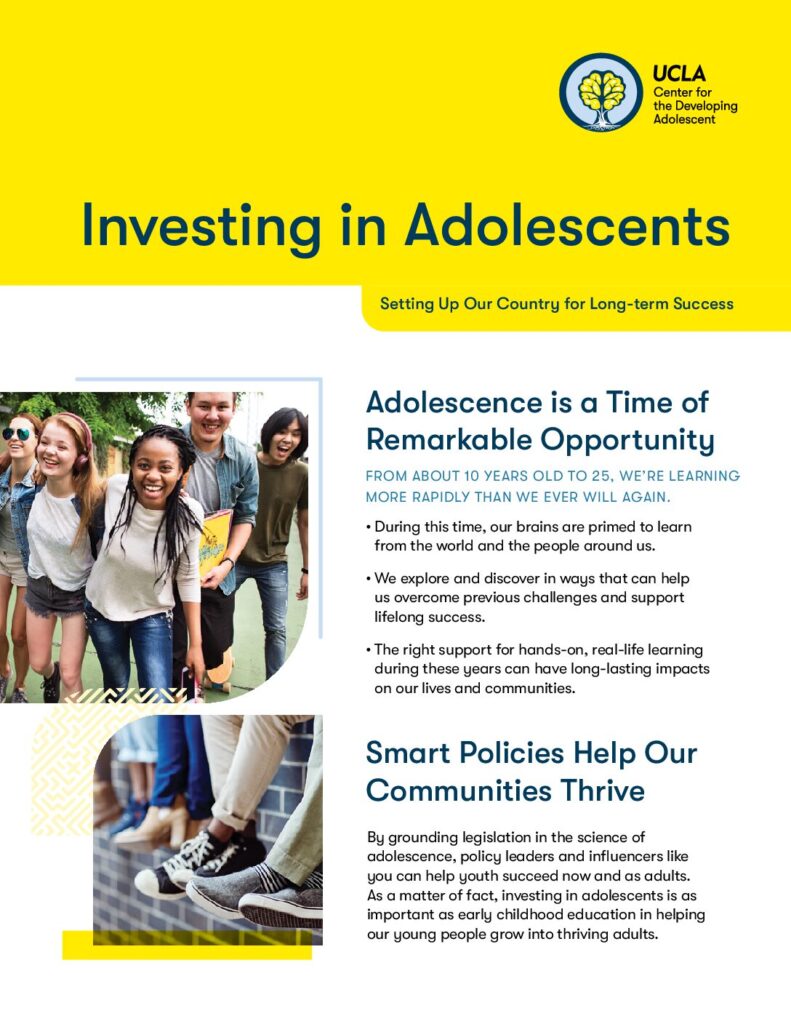
We know that during adolescence our brains are forming connections more quickly in response to our experiences than at any time after early childhood. The extent of these changes make the adolescent years a critical window when research-informed policies and programs for youth can have a lifelong positive impact on health, education, wellbeing, and social as well as economic success.
Likewise, we know that negative experiences during these years, including lack of access to essential resources, exclusion from opportunities, and messages that they don’t belong, can create steeper hills for young people to climb toward a healthy adulthood.
We remain steadfast in our commitment to clearly and accurately share the science of adolescent development to promote positive development for all young people, regardless of economic background, race, immigration status, sexuality, or gender identity.
This is a pivotal moment for our country, our young people, and research innovation. Changes to long-established policies and systems are intersecting with changes in technology and global affairs in ways that may create new opportunities for some while presenting steep new challenges for others. We will continue to operate as a trustworthy source of the developmental science of adolescence. Incorporating a science-based understanding of adolescent development into our collective work can help ensure that our young people have the support they need to build healthy connections—in their world and within their brains—so that they and our communities can thrive.